Just discovered POSSE
TL;DR
Publish on Own Site, Syndicate Elsewhere (POSSE) is an interesting take on growing both authority and authorship. Your content can exist in many places, but only one place is allowed to be the source of truth, better called a canonical link. Here is my attempt at explaining POSSE, and how your ideas can truly be independent of internet social media platforms.I recently discovered POSSE (Publish on Own Site, Syndicate Elsewhere), and you can think of it like this:
Publish on your own site first, then cross-post it everywhere your audience already is.
At first glance it sounds trivial. Another boring “best practice.” POSSE is not a workflow improvement. It is a decision about where truth is allowed to live. Most people miss this because they think in individual posts. POSSE only make sense when you think in systems.
Mental Model I started with
Before POSSE, my mental model was simple:
- Write something
- Publish it on platforms where people already are
- Trust that the platform will keep it available forever
My personal website felt optional, and platforms felt neutral. Nothing broke immediately since it all looked good in isolation, but over time, the system started to rot.
- Edits became inconsistent
- Old ideas resurfaced without context
- Links stopped working
- Posts survived only as screenshots
The question POSSE forced me to ask
POSSE forced a sharper question:
If two versions of the same content disagree, which one is allowed to be correct?
Before, I had no answer, and that meant the platform decides. POSSE answered this explicitly.
What if your site is the source of truth? Every other piece of content you publish links back to your site, where your organic ideas live.
What Syndication actually means
I used to think syndication meant “posting the same thing everywhere.”
In POSSE, it means something stricter. Your content has one canonical origin. You can copy your content anywhere, but you should not let your ideas fragment across the internet.
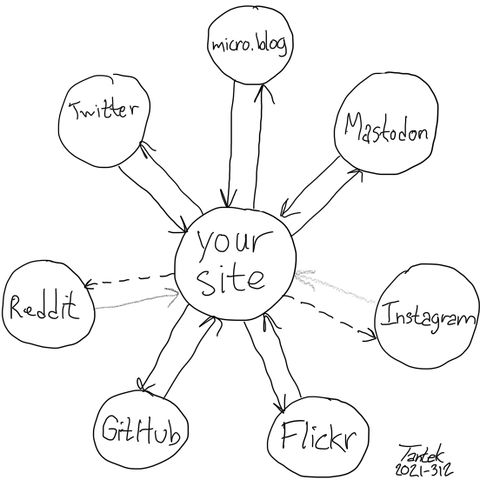
In POSSE, authority always points back to your site. Attribution: IndieWeb
Authority vs Authorship
Authorship is who wrote the words, your name on the book.
Authority is which copy is the master, the version allowed to be corrected, updated, and cited.
You can be the author everywhere. You only get authority in one place, and POSSE makes that place explicit.
The Shift in Publishing
Once you adopt POSSE, engagement becomes secondary. Reach still matters, but it no longer defines your strategy. Regardless of whether your posts perform better, your original content stays permanently on your site, and each platform you publish to becomes a temporary amplifier pointing back to the canonical link.
Long-form writing
Publish the full piece on your site, and keep the URL to that article as your canonical reference.
On each platform:
- Share excerpts or summaries
- Link back to the source
Short-form thoughts
Notes, tweets, and ideas now live on your site first. Social media is no longer your notebook. Platforms become terminals, and your site is the log.
Corrections and edits
The clearest payoff is when you realise you have full control on your content. You can fix errors and revise context in one place, and everything else either updates from that source, or stays visibly outdated.
Platform failure?
Nothing fundamental is lost if your account gets suspended or the platform shuts down. Even if the algorithm decides not to rank your content, your audience can still discover it by searching the web, or through other posts that link to your site.
PESOS: the band-aid
PESOS (Publish Elsewhere, Syndicate on Own Site) answers the same question differently. You publish and share on platforms first, and then embed (or permalink/shortlink) the posts back to your site.
Unlike POSSE, PESOS however only solves one part of the problem. PESOS only provides authorship, but does not provide authority.
In PESOS, content still feels disposable, since you depend on the platforms hosting the content. POSSE provides durability of writing, where your site becomes an archive, and your posts become amplifiers of your content.
The idea, stripped down
POSSE reduces to one rule:
Content may exist in many places, but only one place is allowed to be correct.
Once that rule is clear, everything else becomes mechanical. That is why POSSE is not a workflow tweak. It is an authority decision.
References
In true IndieWeb style, here is the stuff that inspired me to write this blog.
- IndieWeb principles
- Syndication, IndieWeb wiki
- Canonical URL, IndieWeb wiki
- Bridgy, a great tool for POSSE/PESOS
- Resilient Web Design - Jeremy Keith, this is why IndieWeb and POSSE became a thing.